I posted an early preview of a Webtoons but AT Protocol app I’ve been working on earlier today. Just some of the creator dashboard pages. @tynanpurdy.comsuggested I post here for some feedback. I’ve uploaded the lexicons I have so far to this Github repo (sorry not tangled).
I’m not really a data model person or a comic creator so I feel like I’m the worst person to define these things. And frankly, my indecision may be holding back the actual development of the AppView. It feels wrong to have all of the lexicons be app.blampow.* namespaced. I’d rather have an interoperable standard like @standard.site.
Does anyone have any tips on how to approach this indecision? A good domain idea to host a comics lexicon standard? Should I stop worrying about the interoperability and just build on my own lexicon and backfill support for another better lexicon later? Are my lexicons a big dumb mess??
Welcome! Thanks for sharing, and there are definitely folks who can give you some lexicon feedback.
If there are a couple of people interested in sharing, you can totally settle on a shared domain. I took a look and there are some good domains still available.
And yes - build and iterate. As others come along they’ll see if yours are a fit and you can migrate to a shared one in the future.
Hello! I’m new to ATProtocol stuff but I have been a digital artist with an online presence for a little over 10 years. I hope I can offer some valuable insight here.
For the categories one that immediately stands out that I think should be added is furry, since there is a big distinction from the culture compared to simple animals. strip or something of that nature would be nice too I think, for people who do the old fashioned newspaper styled comics.
Speaking of which, I do like traditional page by page comics and prefer to work in that format and I wonder if you could support that by having each slice be its own page and giving the user the option to designate a submission as chapter vs page? Im not entirely sure how difficult that would be in the backend.
However this could potentially help lower the barrier of an artist feeling like they need to have a whole chapter out before releasing, which the webtoons format has popularized but has burnt out a lot of the creatives I know.
Some way for users to show support for a comic beyond commenting would also be lovely. Beyond the traditional favorite or heart even, perhaps reactions? Someone submits a page with a cliffhanger and people can go or . This way those that enjoy ATProtocol but want to avoid Bsky for whatever reason dont have to feel pressure to have a presence in order to support their favorite artists. People like lurking!
Those are all my thoughts for now, I hope it helps!
Thanks @thebee.bz! That’s really valuable feedback! I thought that prioritizing webtoon (vertical) format would help simplify development, but I hadn’t thought about the barrier of entry being higher with the requirement of releasing a whole chapter vs a single page at a time!
I wasn’t planning on having a minimum number of slices. But, I hadn’t thought about a partial chapter release cadence.
Strip format is another good callout. That lexicon would have a Series > Strip > Panel lexicon that could reuse the same Panel lexicon from the page/traditional format. (Panel is basically just x/y coordinates, width, height, and I guess an list of alt text records keyed by language)
I’ll be sure to add furry to my list of categories!
Hello! I am a designer that has read a good deal of fandom webcomics. My first instinct when looking at that video is that the format of the comics there is quite different from the format I am used to, which I often read on their own self-hosted website, Tumblr, and (very newly) Bluesky. Some examples of these comics are: Brainworms, Darths and Droids, and Croissant Adventures. XKCD is not from fandom, but it is a well-known comic presented in a similar format.
Some overall characteristics of this style, as much as it can be treated as a single thing:
The comic is made out of a series of strips/units that each have a small number of images/panels that tell a self-contained story/joke. On a self-hosted site, this is a single page, on Tumblr this is a single post, and on Bluesky it’s 1+ posts that contain all the images.
Strips can have varying lengths across the same comic. Meaning, the same comic can go from two-panel memes to multi-page heartwrenching stories back to two-panel memes.
Strips often come with some amount of text commentary after the images, which can include the creator’s thought process, credit to other people, alt text, and more.
Strips might be tagged with characters or subjects so it is possible for the reader to find other pages with similar content
Creators oftentimes have a place where they link other comics they enjoy, which acts as a discovery mechanism for readers
There may be extra content for paying readers locked behind a Patreon, such as early access material or NSFW
I think that the Webtoons ecosystem is very different, as it’s geared towards long-running stories that are expected to be read in order. By comparison, many fandom comics come in shorter chunks at a time, and may be received by readers out of order, potentially with no context outside of the individual post that has landed on their dashboard (though an overarching story in chronological order sometimes does exist when the reader looks further). I’d love to see this project be able to support the latter type of comics too!
Right now, the current status quo is that many creators repost their comics across their personal site and social media, breaking up the images as necessary to be able to get everything in across size limits and display formats. Even then, their content often gets reposted to other sites without attribution, which means readers who enjoy what they see can’t track down the source to find more. There’s a lot of potential in using ATproto to enable easier cross-posting by creators and sharing with attribution for readers. I think that if this lexicon is able to make that possible, that would solve a big pain point for creators and potentially create more interest in ATproto in general.
Hey! Would love to be part of this / help in creating a lexicon similar to standard.site but for webtoons / webcomics.
I built an open-source comics app (https://inkverse.co). All the comics on there use an open spec I created ( ComicSeries ) which is similar to what you came up with.
I can talk about some of the decisions I made:
Used schema.org vocabulary for ComicSeries as a starting point (which maybe you did too, as I see some similarities between what we come up with)
We do have a different hierarchy, ours is Series → Issues → Stories (each panel that makes up the issue). An ‘issue’ can be a long vertical scroll, a traditional page set, or a single strip.
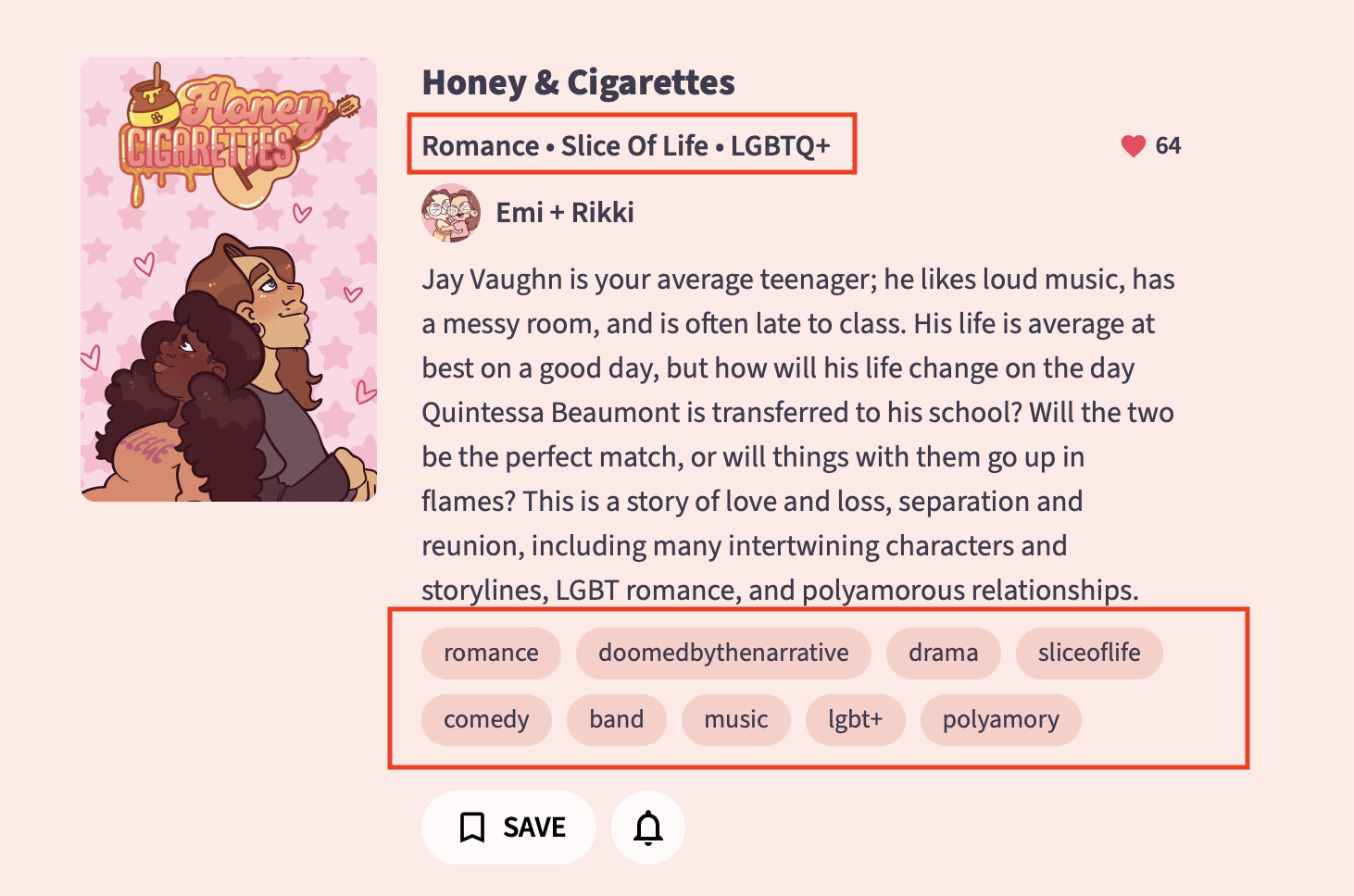
Instead of listing a bunch of categories, we used Genres and Tags. Genres are broad categories like Romance, Action etc. that we have defined and tags are any text the creator wants to add. I think creators really like it, they get to belong to specific genres and get the flexibility to write their own tags which can be very specific to their trope / comic. Here is an example and I highlighted the genres + tags for that comic.
I made a different spec for creators as well, it lists all the content they made, links to their socials, and roles they did for each comic (similar to what you did for credits)
We added small, medium, and large for some images. ex) for the Discovery screen on Inkverse I just need the small image but for the comic screen, I might want the large image. I didn’t define an aspect ratio, but that sounds like a good idea.
I’m a mod of this comic server for webcomic creators: Webcomics Creator Hub There are ~700 creators (maybe 50 active) and they have been helpful / contributed to making the spec the way it is. You should join.
Lastly, this may be a bit controversial for this forum, but I’m not thinking of rebuilding Inkverse on AT Proto (that seems like a lot of work), BUT, I think we could still collab. I would love it if comic creators could use your app to add their comic to their PDS → One of us could create a script that reads this comic from their PDS and creates a JSON in the spec Inkverse uses → Add that feed to Inkverse and now your comic creators have access to the ~500 readers / week on Inkverse (and Inkverse has more great comics).


 . This way those that enjoy ATProtocol but want to avoid Bsky for whatever reason dont have to feel pressure to have a presence in order to support their favorite artists. People like lurking!