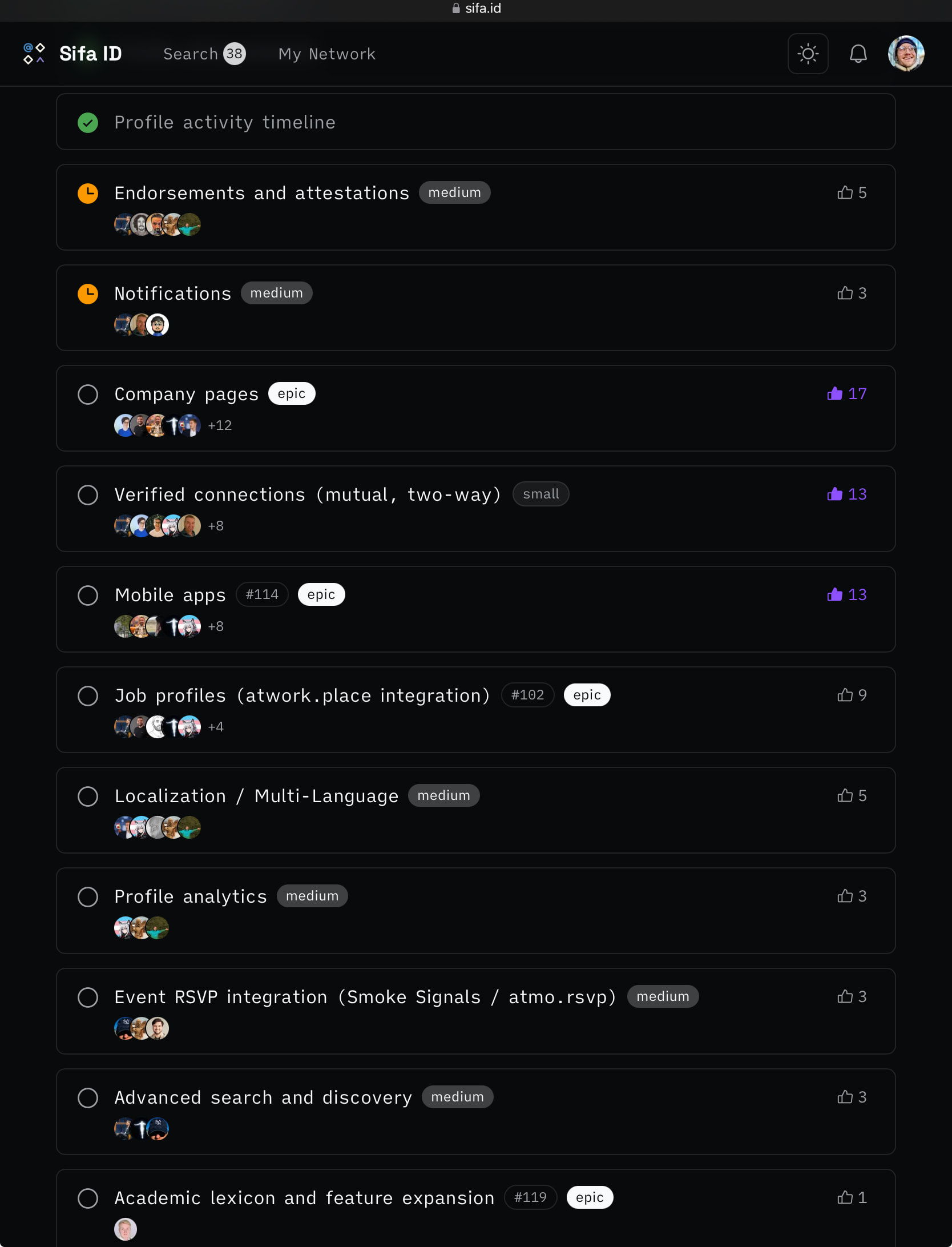
I turned the Sifa frontend/backend repos from public to private. I should have asked for input before doing that, but… here we are.  Note that Sifa was never open source, just publicly visible code (source-available, MIT on lexicons only).
Too much for one person
I spoke to some people experienced in investing and growing companies. First thing they said: having three products (Barazo, Sifa, and a shared trust/reputation layer) is way too much for a small team, let alone a solo founder. Pick one.
The trust/reputation layer isn’t its own product yet (and shouldn’t be right now), but it could be a good add-on business once either Barazo or Sifa is further along. So the real choice is between those two:
- If I pick Barazo: clearer SaaS business case, go up against Discourse and the like. Established market, probably some money in the bank sooner, but less eventual upside.
- If I pick Sifa: more business model options (HR services, verified credentials, fintech, advertising), but none where end users pay directly. That probably means a longer runway to revenue and needing investment. The expectation was that Sifa could have much bigger upside, but it’ll take longer to get there.
Haven’t made that choice yet, but it led me revisit at what makes each product viable as a business.
“Open” matters differently for each
For Barazo, open source has a clear business benefit. Self-hosters still contribute to the AT Protocol ecosystem: their users’ data lives in PDSes, so the lexicon data grows regardless. Self-hosting becomes a natural freemium tier, with upsell to managed hosting and paid
trust/reputation services. The general public doesn’t even need to know the Barazo name for it to work… forum admins are the customer. The average forum user doesn’t know if they’re on Flarum, Discourse, or Vanilla either.
For Sifa, I think this is different: it needs to be a recognizable brand where people share their professional identity link. It helps if there’s a strong network effect, if the recruiter or colleague on the other end actually knows what Sifa is when you send them your link. I’m not saying nobody else should build professional identity on atproto. I’d love that, and the lexicons are MIT for exactly that reason. But I want to compete on UX, brand, and service, not have someone fork whole website and swap the logo. The source-available license already didn’t allow that, but having the code right there makes it a lot easier to do… and I’d rather not deal with that legal distraction on top of everything else. And this seems a risk checkbox on a potential investors checklist so… rather not have it?
Moat?
If your app data is in PDSes (like it is with both products), there’s no data moat in AT Protocol land. That’s why we’re all here… but it also means we need business models that work without one. (I know you can still do private data by having people login with atproto and
storing everything in your own db, but that’s not what I’m doing.)
I get that for investors, no data moat is already a hard sell. Code isn’t much of a moat either, I think that should come from network effects mainly. But letting others copy-paste the entire frontend could look like unnecessary risk to someone writing a check.
Trust though
The other side of the coin: in many ecosystems, having your code visible is a trust signal. Someone can look at what you’re actually doing with their data, how you interact with the protocol. Going private removes that, and in a community built on openness… that’s not
nothing.
Practically, the legal difference between source-available and private is small: someone determined to copy your code could do it either way. The main thing you lose by going private isn’t legal protection. It’s the trust of this community. I’m aware of that, and it’s part
of why I’m not sure this was the right call.
I’d also be happy to give other atproto builders access to a private repo if taht helps you build additional services (like @trysound.io is doing with https://weareonhire.com/, building on Sifa lexicons, super cool) or if anyone wants to review the code.
I know at least one person is already unhappy about this, so maybe the goodwill damage is already done even with a revert 
What others do
Most AT Protocol services are open source: Bluesky (MIT), Streamplace (MIT), Frontpage (MIT), Leaflet (MIT), Smoke Signal (MIT), Tangled (MIT), WhiteWind (AGPL), Graze Social (mixed permissive). Roomy has MPL-2.0 for the app + PolyForm NonCommercial for the services, with a delayed relicense to permissive after 2 years.
Afaik these are closed/private: Skylights, Skylight Social (plans to open source later), Pckt. Not unheard of, but clearly the minority in the atproto sphere
Where I’m at
I’m not 100% sure this is the right call or that it’ll stay this way, and of course changing licenses willy-nilly is shitty and should not happen. I’ve never dealt with investors before, and I’m eager to have at least one of these projects succeed, so I’m learning on the job here. Still very much in alpha, figuring out both the product and the business side.
I think it’s good for the AT Protocol ecosystem to have multiple healthy businesses beyond Bluesky, and I’d like input on how to make that work.
From experience (I worked at Spryker, which is source-available): we had a lot of shops running our proprietary software without a license because the code was right there to copy. Different business model (PaaS), but the legal headaches that caused is one I’d be eager not to repeat. For a product like Sifa where the value is brand and network effects, not self-hosting… does having the code visible hurt more than it helps? Or is that a non-issue and am I completely overthinking this?
But yeah… your view? If you build an atproto app: what license did you pick and why?


 . And you’re right that people will build other clients if this works at all, code visible or not. This is also not something I want to prevent at all (like mentioned in the OP,