Ringspace: a webrings protocol by @taggart-tech.com also fits right in here.
The Web of Trust
What would it take to establish a closed network of creators who afforded some guarantee of humanity and verified identity to both visitors and other members of the network? Uses need two guarantees about a site in order to “trust” it.
Identity: “Are you who you claim to be?”
Reputation: “Are you known to act in good faith?”
No single site can provide these guarantees for itself. An HTTPS certificate does not guarantee identity; it only tells the user that their traffic is encrypted and that the encryption keying material follows a known chain of trust. Neither of those is about identity as we care about it here. Our concern is whether a site is an upstanding member of a trusted community: the webring. To establish our own chain of trust, we might try relying on other members of the ring to verify identity in some way. But mutual webs of trust like that fail in predictable ways, like gaps in the web (one member doesn’t trust the others or intentionally excludes another node) or coordinated attacks on one node.
Certificate trust relies on root certificate authorities that browsers and other HTTP clients have agreed to trust, based largely on reputation. There’s a starting point.
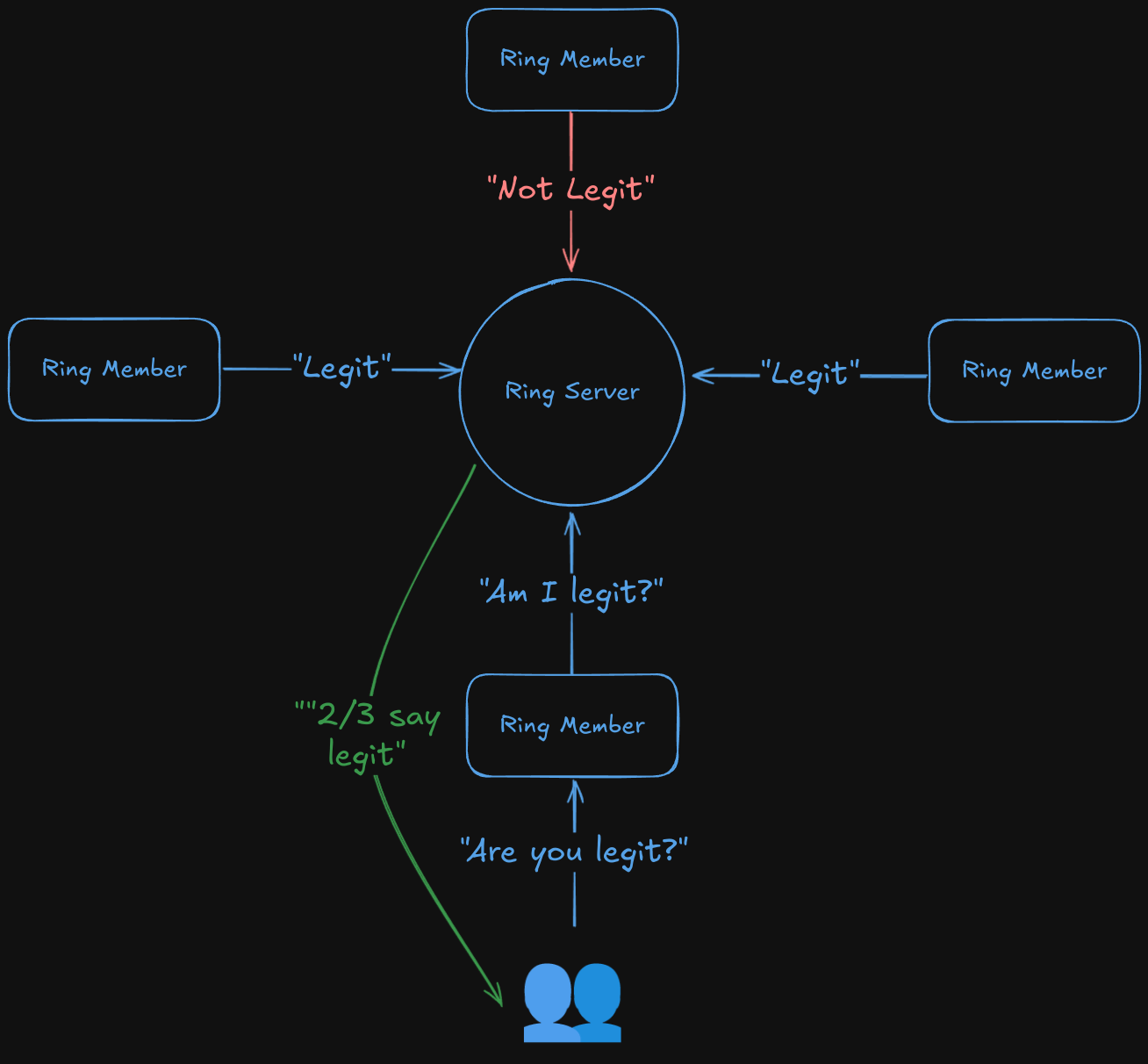
I think a webring with a trust layer needs one too. We’ll call this the “ring server.” Its job is to poll members of the ring for a consensus about identity and reputation—more on reputation later.
The broad strokes look like this:
The ring server provides a “polling place” for members of the ring to contribute their vote on the identity and reputation of other members of the ring. The server compiles the responses and reports back the results to anyone asking—a user visiting the site in question. That user is provided with more than just a checkmark, but a full story about what the ring thinks about this site: whether the identity matches expectations, and whether they are in good standing.